| |
Expedition 7 Mission Journal
|
|
[Home]
[Headlines]
[Space Blog]
[Space Shop]
[Photos]
[Space Quotes]
[Search]
[Soyuz TMA-2 Part 3]
[Soyuz TMA-2 Part 2]
[Soyuz TMA-2 Part 1]
Soyuz TMA-2 Mission Overview
Note: The links below will
open up in one new browser window. For best viewing, size the two web
browsers so that they don't take up the entire screen - this way, you will be
able to go back and forth to all the stories without losing your place.
Click the Refresh button to
make sure you have the newest version.
Mission info from
NASA Human Spaceflight,
Energia Corporation,
and European Space Agency
websites
Expedition Seven Next ISS Crew
 The
International Space Station's next set of residents, the
Expedition Seven crew, is slated to arrive April 28 at [1:56AM EDT/0556 GMT]
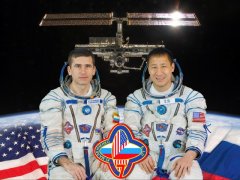
aboard the Soyuz TMA-2 spacecraft. The crew consists of Russian
Cosmonaut Yuri Malenchenko and U.S. Astronaut Ed Lu. Malenchenko and Lu launched
from Baikonur Cosmodrome, Kazakhstan, at [11:54PM EDT April 25/0354 GMT April 26].
The
International Space Station's next set of residents, the
Expedition Seven crew, is slated to arrive April 28 at [1:56AM EDT/0556 GMT]
aboard the Soyuz TMA-2 spacecraft. The crew consists of Russian
Cosmonaut Yuri Malenchenko and U.S. Astronaut Ed Lu. Malenchenko and Lu launched
from Baikonur Cosmodrome, Kazakhstan, at [11:54PM EDT April 25/0354 GMT April 26].
Malenchenko, who will serve as commander, is a veteran of two
spaceflights -- Mir 16 and
STS-106. Lu, who will serve as a flight engineer and NASA ISS Science
Officer, is a veteran of two shuttle flights --
STS-84
and STS-106. They will replace the
Expedition Six
crew, which has been at the station since Nov. 25, 2002. Expedition
Six Commander Ken Bowersox, Flight Engineer Nikolai Budarin and NASA ISS
Science Officer Don Pettit will return to Earth on May 3 aboard the Soyuz
TMA-1 spacecraft currently docked to the station.
Russian flight rules dictate that a Soyuz remains docked to the ISS and replaced
by a fresh Soyuz every six months. Should the station's resident crew encounter
an emergency requiring them to disembark the orbital outpost, they would enter
the Soyuz lifeboat, undock from the station and de-orbit for a landing on Earth.
The Russian spacecraft is certified to remain in space no longer than six months due
to the degradation of its propellant over time and space radiation hazards to the vehicle.
[Home]
[Headlines]
[Space Blog]
[Space Shop]
[Photos]
[Space Quotes]
[Search]
[Soyuz TMA-2 Part 3]
[Soyuz TMA-2 Part 2]
[Soyuz TMA-2 Part 1]
|
Copyright © 1999-2008 Constellation Technology Services LLC. All rights reserved.
|
Top of page
|
Home
|
Revised:
16 Nov 2008